Updated September 2026Which Long Island ZIP codes have the most real estate activity? Based on residential sales reported for the 12 months ending May 31, 2026, ZIP code 11746, covering Huntington

Dated: September 11 2026
Views: 57
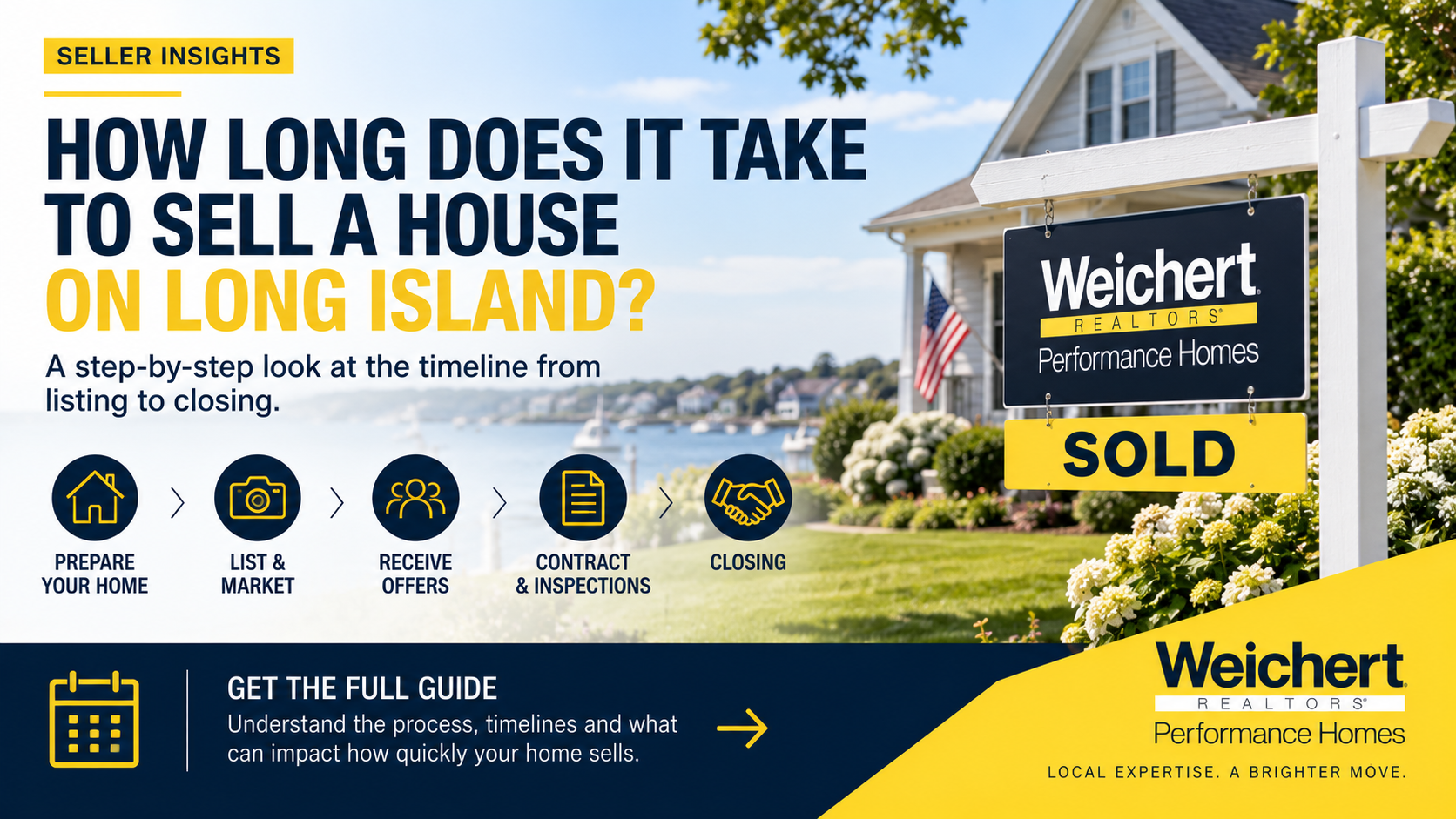
If you're thinking about selling your Long Island home, one of the first questions you're likely to ask is:
"How long will it take to sell my house?"
The answer isn't simply the number of days a property sits on the market.
Selling a home on Long Island involves several stages—from preparing and pricing the property to finding a buyer, negotiating an offer, going to contract and eventually closing.
A home might receive an accepted offer relatively quickly and still take weeks or months to reach the closing table.
So a better question may be:
"How long should I expect the entire Long Island home-selling process to take?"
Let's break it down.
Possible timeline: A few days to several weeks
The selling process actually begins before your home appears online.
Depending on the property, preparation could include:
Some homes need very little preparation. Others benefit from several weeks of work.
The important thing is not to automatically assume that more work is better.
We've covered this in our article What Actually Adds Value Before Selling a Long Island Home?
Sometimes making a few strategic improvements makes sense.
Sometimes the better decision is to bring the home to market without spending heavily on renovations.
Pricing can have a major effect on what happens next.
Sellers sometimes think:
"We can always start high and lower the price later."
Technically, you can.
But the first days and weeks of a listing can be an important period because that's when the property is new to the market and potentially being seen by many active buyers for the first time.
The goal isn't necessarily to choose the highest possible asking price.
It's to establish a price and marketing strategy designed around:
Our Pricing Strategy Session is designed specifically around this conversation.
Possible timeline: Days, weeks or longer
This is the part most people think of as "time on market."
How quickly a Long Island home receives an acceptable offer can depend on several factors:
Some properties may attract significant activity immediately.
Others take longer to find the right buyer.
There isn't a responsible way to promise exactly how many days a particular house will take to sell without evaluating the property and current market.
This is an important distinction.
When you see that a home sold after a certain number of days on market, that doesn't necessarily mean the seller received their money that quickly.
Days on market generally measures the marketing period—not the entire transaction from listing through closing.
Once a seller accepts an offer, there are still several steps ahead.
That's why homeowners planning a move shouldn't build their entire timeline around an average days-on-market statistic.
Getting an offer is exciting.
But the highest number isn't automatically the best offer.
A seller may need to consider:
The objective is to evaluate the complete offer, not simply the number at the top.
Once the seller and buyer agree on the major terms, the transaction moves toward the attorney and contract stage.
New York's real estate process is different from what buyers and sellers may read about online in other states.
An accepted offer generally does not mean the transaction is immediately under a fully executed contract.
The attorneys become involved in preparing and negotiating the contract.
Depending on the circumstances, the buyer may also complete inspections during this period.
Only after the contract is finalized and signed by the parties does the transaction move into the next phase.
This period is another reason why "accepted offer" and "sold" are very different milestones.
Possible timeline: Several weeks
If the buyer is financing the purchase, the lender has work to complete before closing.
That process can involve:
Meanwhile, the attorneys, lender, title company and other parties may be working through the transaction.
Cash transactions can remove some financing-related steps, but they still require legal and title work.
As the transaction moves toward closing, there may still be items that need to be coordinated.
That can include:
The attorneys ultimately coordinate the closing.
Once the transaction closes, ownership transfers to the buyer and the seller receives the proceeds according to the closing statement.
Rather than assuming one fixed number, it is usually better to think of the process in two major periods:
1. Time to find and secure the right buyer
and
2. Time from accepted offer through contract and closing
The first period depends heavily on the property and current market.
The second depends on financing, attorneys, title, property-specific issues and the circumstances of both parties.
That's why someone who needs to be moved by a particular date should begin planning well before that deadline.
Not every seller has the same objective.
One homeowner might say:
"I want to maximize the opportunity, and I have plenty of time."
Another might say:
"I need to relocate by November."
Another might need to sell their current home before purchasing the next one.
Those are different situations and may require different strategies.
Your timeline can influence decisions involving:
This is why we prefer to understand the seller's entire situation before talking about a listing price.
This is where planning becomes particularly important.
If the proceeds from your current home will help fund your next purchase, you need to think beyond simply getting your house sold.
You may need to coordinate:
Sale → proceeds → purchase → closing → moving
There are several ways buyers and sellers may structure these transitions depending on their circumstances.
If you're also purchasing another Long Island home, our Buyer Consultation can help you think through the buying side of the move.
There isn't one "Long Island housing market."
Conditions can differ between communities, property types and price ranges.
A home in Farmingdale may face a different competitive environment than a home in Massapequa—and two homes within the same community may appeal to different groups of buyers.
That's why we maintain local resources including:
Farmingdale Market Intelligence
Massapequa Market Intelligence
You can also explore additional areas through our Long Island Communities Hub.
You can't control every part of a real estate transaction.
But good preparation can help reduce avoidable surprises.
Before listing, it can be useful to:
The earlier these conversations happen, the more options you generally have.
You don't need to wait until you're ready to put a sign on the lawn.
If you think you may sell within the next several months, that's often a good time to start gathering information.
An early conversation gives you time to understand:
There shouldn't be pressure to list simply because you started planning.
Selling a Long Island home is a process, not a single date on the calendar.
Finding a buyer is only one part of it.
Preparation, pricing, marketing, negotiation, contracts, financing, title work and closing all contribute to the overall timeline.
Instead of asking only, "How fast can you sell my house?", consider asking:
"What is the best strategy for getting from where I am today to where I want to be next?"
That's a much more useful conversation.
If you're considering selling within the next 3–12 months, you can start with our Pricing Strategy Session to understand your home's position in the market and begin building a timeline around your goals.

Jared Garcia is the Broker/Owner of Weichert Realtors Performance Homes, a leading Long Island real estate brokerage serving buyers, sellers, investors, and real estate professionals throughout Nassau....
Updated September 2026Which Long Island ZIP codes have the most real estate activity? Based on residential sales reported for the 12 months ending May 31, 2026, ZIP code 11746, covering Huntington
If you're thinking about selling your Long Island home, one of the first questions you're likely to ask is:"How long will it take to sell my house?"The answer isn't simply the number of days a
Farmingdale, NY Real Estate: What Buyers and Sellers Should Know About the Local MarketIf you're thinking about buying or selling a home in Farmingdale, New York, understanding the local market
Hidden Costs of Buying a Home on Long Island: What Buyers Should Budget for Beyond the Purchase PriceWhen you're searching for a home on Long Island, it's easy to focus on two numbers:The purchase
 OneKey® MLS required Copyright, Source of Data and Disclaimer for IDX display
Information Copyright 2026, OneKey® MLS. All Rights Reserved.
The source of the displayed data is either the property owner or public record provided by non-governmental third parties. It is believed to be reliable but not guaranteed. This information is provided exclusively for consumers' personal, non-commercial use.
The data relating to real estate for sale on this website comes in part from the
IDX Program of OneKey® MLS.
OneKey® MLS required Copyright, Source of Data and Disclaimer for IDX display
Information Copyright 2026, OneKey® MLS. All Rights Reserved.
The source of the displayed data is either the property owner or public record provided by non-governmental third parties. It is believed to be reliable but not guaranteed. This information is provided exclusively for consumers' personal, non-commercial use.
The data relating to real estate for sale on this website comes in part from the
IDX Program of OneKey® MLS.
33. Required DMCA Notice
The Digital Millennium Copyright Act of 1998, 17 U.S.C. §512, the DMCA, provides recourse for copyright owners who believe that material appearing on the Internet infringes their rights under U.S. copyright law. If you believe in good faith that any content or material made available in connection with our website or services infringes your copyright, you (or your agent) may send us a notice requesting that the content or material be removed, or access to it blocked. Notices must be sent in writing by email to DMCAnotice@MLSGrid.com. The DMCA requires that your notice of alleged copyright infringement include the following information: (1) description of the copyrighted work that is the subject of claimed infringement; (2) description of the alleged infringing content and information sufficient to permit us to locate the content; (3) contact information for you, including your address, telephone number and email address; (4) a statement by you that you have a good faith belief that the content in the manner complained of is not authorized by the copyright owner, or its agent, or by the operation of any law; (5) a statement by you, signed under penalty of perjury, that the information in the notification is accurate and that you have the authority to enforce the copyrights that are claimed to be infringed; and (6) a physical or electronic signature of the copyright owner or a person authorized to act on the copyright owner\'s behalf. Failure to include all of the above information may result in the delay of the processing of your complaint.
Show More...