Updated September 2026Which Long Island ZIP codes have the most real estate activity? Based on residential sales reported for the 12 months ending May 31, 2026, ZIP code 11746, covering Huntington

Dated: August 21 2026
Views: 180
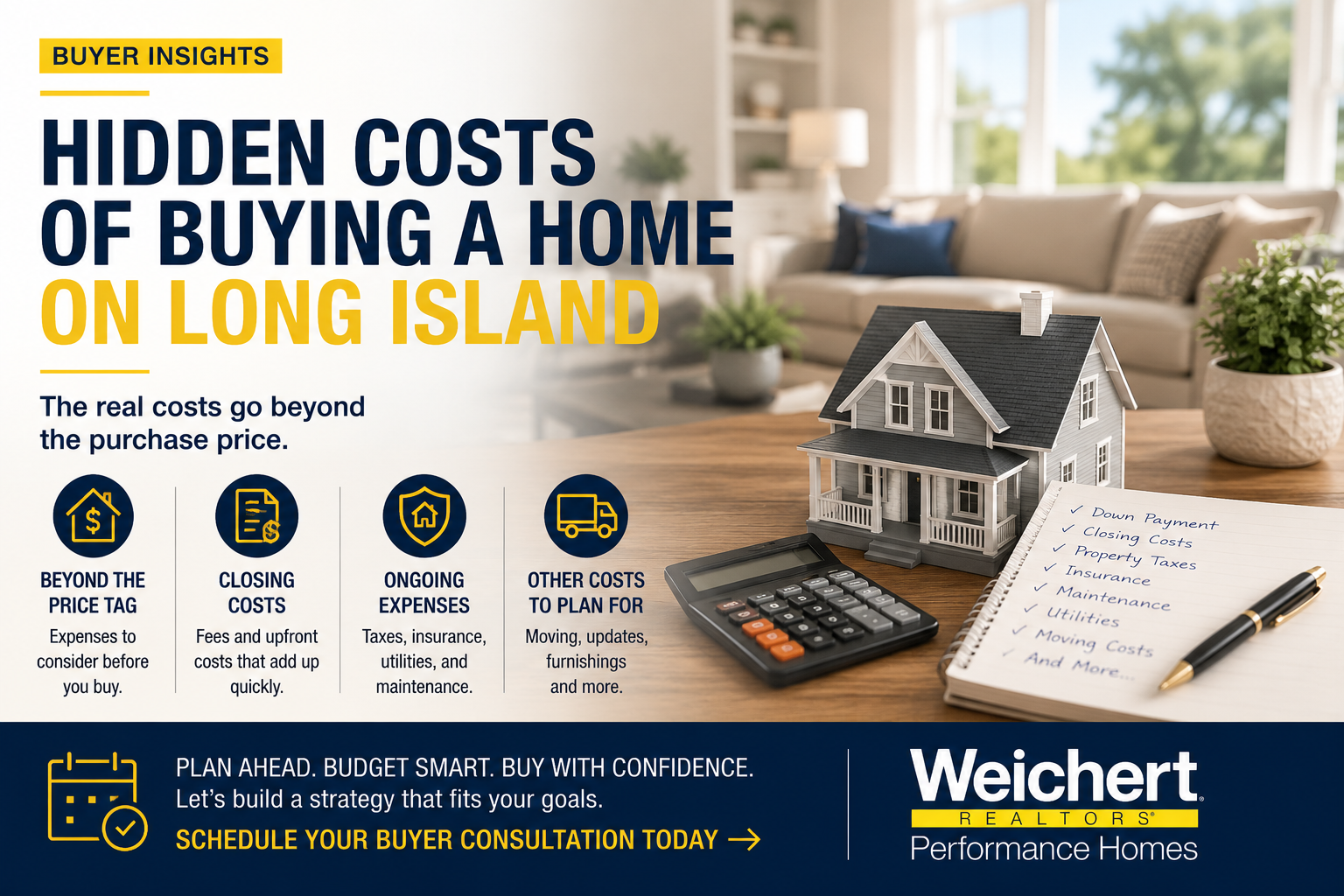
When you're searching for a home on Long Island, it's easy to focus on two numbers:
The purchase price and the monthly mortgage payment.
But those numbers don't tell the entire story.
Property taxes, closing costs, homeowners insurance, inspections, utilities and ongoing maintenance can all affect what a home actually costs to own.
That's why one of the most important questions buyers should ask isn't simply:
"How much house can I afford?"
It's:
"What will this home realistically cost me to buy and own?"
If you're planning to buy in Nassau County, western Suffolk County or elsewhere on Long Island, here are some of the expenses worth considering before you start making offers.
Property taxes are one of the biggest expenses Long Island buyers need to consider.
Two homes with similar sale prices can have very different monthly costs because their property taxes are different.
For example, a house with higher annual taxes may cost hundreds of dollars more per month than another similarly priced home.
That's why buyers shouldn't evaluate affordability based on purchase price alone.
When comparing homes, look at the complete estimated monthly payment, including:
Your lender can help you estimate these numbers based on your financing.
If you've saved enough for a down payment, that's a great start.
But don't assume your entire savings can go toward it.
Buyers generally need additional funds for closing-related expenses.
Depending on the transaction and financing, these may include items such as:
The exact expenses vary from transaction to transaction.
Before determining how much you're comfortable putting down, speak with your lender and attorney about the cash you should expect to need at closing.
Most buyers want to better understand the condition of a property before moving forward with the purchase.
That often means hiring a licensed home inspector.
Depending on the property, buyers may also consider additional inspections or testing.
The exact inspections that make sense will depend on the home.
While inspections add another expense during the buying process, they can provide valuable information about the property you're considering purchasing.
Don't assume every Long Island home will cost roughly the same amount to insure.
Insurance premiums can be affected by factors involving the property itself, coverage selected and other underwriting considerations.
Certain properties may require additional investigation into things such as flood insurance or other coverage.
Before purchasing, it's worth obtaining an insurance quote rather than simply estimating what the premium might be.
This is particularly important because your insurance cost becomes part of the ongoing expense of owning the property.
Moving from an apartment, condominium or smaller house into a single-family home can change your monthly expenses.
Depending on the property, you may be responsible for:
Older and larger homes can also have very different operating costs from newer or smaller properties.
Ask questions about the home's systems while you're evaluating the property.
This is one of the easiest expenses for buyers to overlook.
When you own the home, you're responsible when something needs attention.
Over time, that can include:
That doesn't mean all of these expenses are waiting for you immediately after closing.
It means buyers should avoid structuring their purchase so tightly that an unexpected repair becomes a financial crisis.
Keeping some reserves after closing can be an important part of responsible homeownership.
Long Island has a wide variety of housing.
Depending on the community, you might find Capes, Colonials, ranches, split-levels, expanded Levitt-style homes and properties that have been renovated or expanded several times over the decades.
Older doesn't automatically mean problematic.
But buyers should understand what they're purchasing.
Things such as the age and condition of the:
can affect future expenses.
A home with a beautifully renovated kitchen can still have older major systems.
Look beyond finishes.
For many Long Island buyers, location is closely connected to commuting.
If you're traveling into New York City or another employment center, consider what your location means for:
A home that's less expensive but significantly farther from work isn't necessarily less expensive overall.
The financial cost matters, but so does the value of your time.
The expenses don't stop when you get the keys.
New homeowners frequently find themselves purchasing things they didn't need in their previous home.
That could include:
Individually, some of these aren't major expenses.
Together, they can add up quickly.
It's another reason why using every available dollar for your down payment isn't always the right strategy.
This is an important distinction.
Imagine you're comparing two Long Island homes.
One has a lower purchase price but higher property taxes, older mechanical systems and significant work that you'll likely need to complete.
Another costs more upfront but has lower taxes and several recently updated major systems.
Which is the better financial decision?
There isn't enough information to answer that based on price alone.
That's why buyers should evaluate the total picture, not simply sort listings from lowest price to highest price.
Even neighboring communities can offer different combinations of home prices, property taxes, housing styles, commute options and amenities.
If you're still deciding where you want to buy, our Long Island Communities Hub can help you begin exploring the areas we serve.
You can also dig deeper into individual communities through our local Market Intelligence pages, including:
Farmingdale Market Intelligence
Massapequa Market Intelligence
These resources are designed to provide more local context than national real estate headlines can offer.
There's a difference between the maximum amount you may qualify to borrow and the amount you're comfortable spending every month.
Before seriously searching for homes, consider the entire cost of homeownership.
Think about:
The objective isn't necessarily to purchase the most expensive home you can qualify for.
It's to find a home and payment structure that make sense for your life after closing.
A productive home search begins before the first showing.
Understanding your financing, priorities, target communities and comfortable monthly expenses can help you search more effectively.
Our Buyer Consultation is designed to help Long Island buyers understand the process and create a plan before they're deep into their home search.
Whether you're a first-time buyer, moving up, downsizing or relocating within Long Island, having that strategy in place can help you evaluate properties based on more than the asking price.
The purchase price of a Long Island home is important.
But it's only one part of what the home will actually cost you.
Property taxes, insurance, closing expenses, utilities, commuting, maintenance and future repairs should all be part of the conversation.
The more you understand those expenses before making an offer, the better equipped you'll be to evaluate whether a particular home truly fits your budget.
And sometimes the home that looks more expensive on the listing page can make more sense once you look at the complete picture.
Schedule a Buyer Consultation and start building a Long Island home-buying strategy around your actual goals and budget.

Jared Garcia is the Broker/Owner of Weichert Realtors Performance Homes, a leading Long Island real estate brokerage serving buyers, sellers, investors, and real estate professionals throughout Nassau....
Updated September 2026Which Long Island ZIP codes have the most real estate activity? Based on residential sales reported for the 12 months ending May 31, 2026, ZIP code 11746, covering Huntington
If you're thinking about selling your Long Island home, one of the first questions you're likely to ask is:"How long will it take to sell my house?"The answer isn't simply the number of days a
Farmingdale, NY Real Estate: What Buyers and Sellers Should Know About the Local MarketIf you're thinking about buying or selling a home in Farmingdale, New York, understanding the local market
Hidden Costs of Buying a Home on Long Island: What Buyers Should Budget for Beyond the Purchase PriceWhen you're searching for a home on Long Island, it's easy to focus on two numbers:The purchase
 OneKey® MLS required Copyright, Source of Data and Disclaimer for IDX display
Information Copyright 2026, OneKey® MLS. All Rights Reserved.
The source of the displayed data is either the property owner or public record provided by non-governmental third parties. It is believed to be reliable but not guaranteed. This information is provided exclusively for consumers' personal, non-commercial use.
The data relating to real estate for sale on this website comes in part from the
IDX Program of OneKey® MLS.
OneKey® MLS required Copyright, Source of Data and Disclaimer for IDX display
Information Copyright 2026, OneKey® MLS. All Rights Reserved.
The source of the displayed data is either the property owner or public record provided by non-governmental third parties. It is believed to be reliable but not guaranteed. This information is provided exclusively for consumers' personal, non-commercial use.
The data relating to real estate for sale on this website comes in part from the
IDX Program of OneKey® MLS.
33. Required DMCA Notice
The Digital Millennium Copyright Act of 1998, 17 U.S.C. §512, the DMCA, provides recourse for copyright owners who believe that material appearing on the Internet infringes their rights under U.S. copyright law. If you believe in good faith that any content or material made available in connection with our website or services infringes your copyright, you (or your agent) may send us a notice requesting that the content or material be removed, or access to it blocked. Notices must be sent in writing by email to DMCAnotice@MLSGrid.com. The DMCA requires that your notice of alleged copyright infringement include the following information: (1) description of the copyrighted work that is the subject of claimed infringement; (2) description of the alleged infringing content and information sufficient to permit us to locate the content; (3) contact information for you, including your address, telephone number and email address; (4) a statement by you that you have a good faith belief that the content in the manner complained of is not authorized by the copyright owner, or its agent, or by the operation of any law; (5) a statement by you, signed under penalty of perjury, that the information in the notification is accurate and that you have the authority to enforce the copyrights that are claimed to be infringed; and (6) a physical or electronic signature of the copyright owner or a person authorized to act on the copyright owner\'s behalf. Failure to include all of the above information may result in the delay of the processing of your complaint.
Show More...